I've been listening to the discussions of data recovery technicians for many years. As such, I took a guess at the results before the page loaded.
And I was right. Seagate bad. Hitachi best. WD almost as reliable as Hitachi.
I can recall one or two bad WD models over recent years, the one at the top of my memory is the 500GByte WD5000AAKS. There was a flaw in the WD10EACS that made it park too frequently, but at least it had a parking ramp.
Hitachi has been a good vendor since the "deathstar" glass platter fiasco blew over. Now: Deskstar 7K's forever!
On the other hand, Seagate seems to ship flaw after flaw. Lately they tend to have spindle bearings that die if the drive gets bumped. If that doesn't happen, surely a head will go bad.
It's funny how things can turn around so completely. Around the time of the Deathstar fiasco, you couldn't pay me to use a Hitachi. Seagate was the brand to buy. Now it's the complete opposite.
Me, too. I put one in my RAID, with part of my strategy is to use a variety of manufacturers and drive types so the drives don't fail all at once. This one is 50x the capacity of my cursed 75GXP...
I'm going to be mad forever at WD for pioneering the approach to distributing drive firmware & tuning parameters over both stripe 0 and the drive's on-board ROM, making board swaps impossible for small shops.
But I'm really disappointed at what's happened to Seagate. I've gone from total confidence in recommending their products to actively recommending against the brand in just a couple of years, and our experiences roughly match Backblaze's. (Though on a much much smaller scale.)
In the older days some of these disks had a discrete rom for this, but recently they have been integrated into a larger chip. It seems that if you have the rework skills, you can transfer the chip with integrated memory to the new board. It's certainly gross when the spindle motor driver on one of these boards explodes.
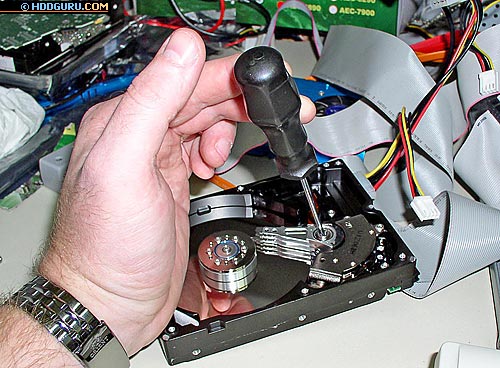
However if you take the lid off a WD drive, the head arm pivot goes out of alignment, since it is secured in place by one of the lid screws. So, if you have to swap internal parts for data recovery, you should own or make a jig to hold the top of the pivot and make fine adjustments, or you will never be successful. Depending on your skills, this may present more difficulty than reworking a board for a swap.
Luckily I have never had to try a DIY data recovery.
> However if you take the lid off a WD drive, the head arm pivot goes out of alignment, since it is secured in place by one of the lid screws.
Oh god, how did I forget about that? Yeah, the guys on hddguru had things to say about that a few years back. A few folks made some really good side money making a tool specifically for realigning the heads on those WD drives.
I used to do the very occasional DIY data recovery for people that had the need but not the money for a professional recovery. My last one was well over 5 years ago, WD and the others made it impossible for people like me to do it anymore. (We still can do recoveries on failing drives under very limited circumstances using a custom server/software we patched together.)
You really have to pay for expensive yearly training and piles of equipment to do data recoveries now.
Seagate started tanking, not surprisingly, shortly after they acquired Maxtor. Generally the last good stretch of Seagate drives was just before 750GB was the top size.
When the drives started reaching 1TB capacity... There were models where they started throwing Seagate branded drives into Maxtor external cases... And that was when it all went to shit. The infamous 7200.11 series.
Dealing with the 7200.11 drives was like the capacitor plague. They seemed to work well long enough to get other people to buy loads... then the firmware problems... then the sudden head crash problems... then the sudden won't power up anymore after a reboot problems...
All the same kind of shit that people saw with Maxtor post 2GB that caused people to stop using those drives en masse. Those old 2GB Maxtor drives were reliable as fuck, though.
I'd normally end something like this with a bit about how history repeats itself and I fear for the next drive company that will get bought out by Seagate, but when you look at it... We're down to two with a small smattering of subsidiaries that no one can really be sure are rebrands or proper made drives.
Case in point. Hitachi is owned by WD and Samsung HD is owned by Seagate now. Toshiba owns some WD assets and bought out Fujitsu's HD division. Beyond that, not much left.
And they put out a ridiculous amount of heat too. I found a one that was too hot to touch in a 24 drive array which heated up the drives adjacent to the point that they too refused to work. So what looked like an extremely unlikely double drive failure ended up being only one.
> There was a flaw in the WD10EACS that made it park too frequently,
I don't know that specific model but frequent parking is not a bug, it's a (highly annoying) feature of (most?) 2.5" and green 3.5"WD drives for some years.


And I was right. Seagate bad. Hitachi best. WD almost as reliable as Hitachi.
I can recall one or two bad WD models over recent years, the one at the top of my memory is the 500GByte WD5000AAKS. There was a flaw in the WD10EACS that made it park too frequently, but at least it had a parking ramp.
Hitachi has been a good vendor since the "deathstar" glass platter fiasco blew over. Now: Deskstar 7K's forever!
On the other hand, Seagate seems to ship flaw after flaw. Lately they tend to have spindle bearings that die if the drive gets bumped. If that doesn't happen, surely a head will go bad.