I dream of one day when someone will make a minimalist phone that meets my needs. The perfect phone for me would be this:
- Can make and receive calls and texts.
- Has a phone book (just a name/number key-value pair).
- Has a clock and timer/alarm.
- NO OTHER SOFTWARE FEATURES. Nothing extra other than calls, texts, phone book, time.
- Small e-ink display.
- Simple T9 keypad.
- Rugged construction, should be able to take a lot of abuse. Should not feel cheap.
- Small and thin.
- Tons of battery life.
- Beautiful, minimalist visual design.
- Cheap enough that you can lose it without feeling bad.
That's all I want - something optimized for calls and texts, nothing more or less. It would be a cheap phone to produce, I think. Would there be any market for this?
EDIT: the Motofone looks like it's kind of like this (http://en.wikipedia.org/wiki/Motorola_Fone), but it has a segmented display (bad for texts), and it sounds like it feels a bit cheap. It could also be prettier.
What is wrong with a classic nokia phone? The battery life is easily a week on some of them and other than the e-ink they basically have all of these features.
I have a Samsung Convoy II. It's not super-thin, but it does pretty well as just a phone (plus texts). It actually has a decent web browser for when you need to check email (about once a month something comes up). Ruggedized, waterproof, and well-made. I think I paid $70 for it on eBay (in brand-new condition). Doesn't have an e-ink display, but I'll deal with that.
I got a low-battery warning this morning, and realized that I hadn't charged it since last Sunday (a week ago). Plugged it in for an hour, and the battery was full again.
I take your list and modify these:
- Can make calls and/or emails
- has a phonebook with name and number/email
Ok so really I want a pure email and/or phone call device. I doubt anything of the sort will be available in the near future so I just have to make my own. We'll see how that works out.
I would really love it though if they made an open (in the sense of iOS/Android at least) operating system for such phones (yes, monochrome and with CPUs in single digit MHz probably) It would allow for third-party applications (or, at a pinch, I could write one myself) that no phone or watch manufacturer ever makes right. Like UI customization for texts or alarm clock that makes sense for polyphasic sleep. But this, I'm afraid is a thing that will never be made: all innovation seems to be in the segment of touch-screen slate phones nowadays.
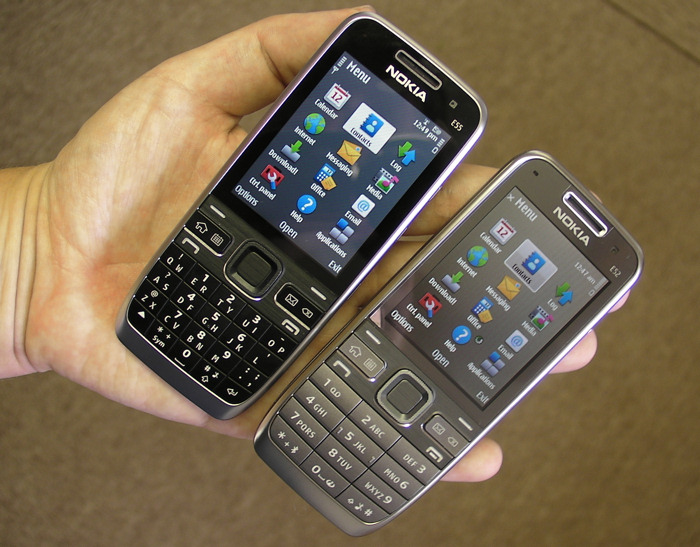
Just doesn't make much sense. Most input you are going to do is textual, ie. names and sms messages. Thus keypad optimized for that purpose would be more reasonable. Full QWERTY is probably impractical due desired small form factor, but there could be some good compromised solution. Maybe something like in E55?
You need what's called a senior phone or old person phone, which is a huge market in China, but somewhat limited in the US. Huge keypad, small black and white screen, long battery life, and few features.
I have seen two of these in Germany and was disappointed. They have all the obvious things - bigger keys, bigger numbers on the display - but none of the perfection that is expected from a mainstream smartphone these days.
Like, the iPhone? Or maybe a Lumia 800? They both fit comfortably in all mens' pockets (and most women's, assuming they have pockets).
The problem is Android is such a power hungry OS that you need to be constantly updating the specs as hardware and app demands grow higher, and high-end specs require space to fit everything in (including ever-growing battery demands), so small Android handsets have to make compromises on specs. It feels sort of like PCs did 10 years ago - 3 years of use and your top-of-the-line PC was near unusable. I find Windows Phone and iOS don't suffer from this nearly as much.
It isn't android. It's the manufacturer skins. AOSP Jellybean runs really smooth on my low end phone. (512 MB ram, 600 MHz processor) But HTC Sense 4 runs like crap.
It's a bit of both. The original Galaxy S (which was only a year and a half old at the time, and was a top-of-the-line phone) struggled really hard with stock android ICS for me.
Try Sony Xperia U. I have the previous model Xperia ray and have been very happy with it. Great display (3.3 inch widescreen high-DPI), great camera, okay processor, would prefer more memory. It's so small that just about everyone mistakes it for a feature phone.
I have a Lenovo S220, a China only phone not appreciably smaller than a Samsung Note. It fits just fine into the front pockets of all of my jeans and cost 2000 Yuan which is a little over $250. If you're male you should not have any problems finding a phone that fits your criteria unless you demand a “free” phone. Even some women's clothes have suitable pockets.
For what it's worth: Onyx, the manufacturer, only half-heartedly support their current e-ink readers, leaving lots of annoying bugs unfixed. However, there are very concrete rumors that Android is also being ported to the some Onyx e-ink readers [1].
I have been wanting this for a while and I still can't figure out why no one has released one. In my mind, my cell phone (or tablet) should be an all in one device - which to a large degree is becoming the case. I hated having a stand alone MP3 player, GPS receiver and camera. Now that e-readers (and wannabe e-readers - kindle fire, ipad, etc.) are becoming mainstream, I don't want my next phone (first tablet) to be without a low power screen. I am a bit disappointed in the average consumer though - it seems like they have a hard time understanding the advantages of e-ink screens or they are ok with reading on an ipad/kindle fire as it can do more than a basic e-reader. If executed well, it could be a major product enhancement and give a mobile device make an edge for a while, esp. considering it would be cheap to add - the screen and the minimal amount of hardware to interface that with the rest of the phone.
Can one or the other be (more or less) completely transparent? Is it possible to have one screen layered over the other such that the LCD only becomes active when the user is directly interacting with the device?
This could become an awesome secondary travel/camping phone. Sure when I'm home I generally remember to charge my phone every or every other night, but when out and about there are many times when charging is inconvenient of impossible.
Sure, I do the same. But having smart phone features like e-mail and a web browser would no doubt be handy at times. For example looking up bus/train schedules for getting home in case you end up delayed or have to change your route.
You have a phone which you can charge every "other" night and still be running? In my experience the Driod Razr Maxx is the only modern smartphone you can really do that with.
I have an Acre Liquid somethingorother I picked up for $200 or so when my phone died last spring. It's been 14 hours since I took it off charging, and in that time I've made a few phone calls, listened to a couple of hours of mp3s, read a dozen web sites or so, checked my email a couple of times and played a simple game for about 15 minutes and my battery is at 63%.
Is "week long battery life" really a killer feature? As long as a phone has enough battery to make it through the 16 hours per day most of us are awake, anything more is just gold plating.
Just how big is the "week long battery life" niche?
Anyone without reliable access to electricity, or who want to stay connected if it's lost. Hikers and other outdoorsmen. Survivalists. People who live in areas prone to natural disasters that can knock out electricity. People living in countries with poor infrastructure.
When I was in college, a hurricane knocked out electricity on my block for about a week. By careful rationing of my UPS battery I was able to briefly use the internet a few times a day, just enough to check my e-mail and get updates on the situation. I think keeping a few low-power "backup" devices (and a portable solar panel or hand crank) seems like a decent investment.
Most phones should run for a week with no issues if rarely used. This (I guess, the site not loading) promises a week of active usage. It is useless as "normal" smartphone though because e-ink has a lot of latency and a low refresh rate.
edit: peterwiese, you have been ghosted for 2 months or so :(
for me this is a feature: not having to think about or doing the effort of putting the phone in the charger every single day? I'll sign for that. (it's also marginally cheaper since you don't waste elektricity if using the charger only once a week vs every day. And it makes it useful in countries not having power everywhere)
Yes. It sucks to worry about your chargers when you're not going home for the night (trips or something more spontaneous).
Even for a 9-5 family lifestyle, charging every night is a
habit you have to learn and you need to keep chargers around
your night table.
Phones used to work like this (run for a week) before the
current smartphone craze. For other stuff you could have
a PDA that wouldn't leave you incommunicado if it ran out
of juice.
It could be useful in India or African countries with not much access to energy. But I doubt people from developed nations would want this. It most likely offers nowhere near the experience of an LCD device. Remember, besides the lack of color issue, e-ink devices work best when the on-screen image is static, and not changing often.
I go on cycle tours every now and then, camping some of the time. I'd love a backup phone for use during tours that could hold a usable charge for 4 or 5 days.
My father does motorcycle touring and would love the same.
I have an old Sony Ericsson M600i symbian phone ( http://www.gsmarena.com/sony_ericsson_m600-1425.php ) I dig out for when I go travelling. The battery is still good for 10 days stand-by. It's such a pain to resync contacts, mail, etc... that all I really do is move the SIM over and use a travel email account.
If I could have the battery life of the old phone with the functionality of a new smart phone, then I'm very willing to sacrifice the screen quality to achieve it.
I have a 12V plug on my motorcycle (fused, regulated. I installed it for like 10 bucks). I also have a couple of solar chargers, they hold 2 AA batteries. They take about 8 hours of sunlight to fully charge and can put an iPhone into the 70% range.
When there's sunlight, you want to be out riding, not sitting around waiting for your phone to charge! And plugging/unplugging the phone every time you get on/off the bike is annoying.
It's the rest of the functionality of a smartphone that drains it sadly, not just the screen. If I turn off 3G and wifi on my SGS2, the battery life goes from around half a day to almost a week!
Maybe, but maybe not. If done well it could be an excellent travel phone. Personally, I like the idea.
Battery life is very important for a lot of people, especially when travelling. It would fantastic for reading on. It might be very light. Attractive travel phone.
If you think about it a minute, a lot of apps might be just as good with a simple, e-ink friendly UIs: exercise apps, audio players, chess, stop watch, contacts, weather, expensify, sms, skype, whatsapp, calendar, newspapers, bus schedule.
In fact, most apps either present information that you read (like magazines or calendars) or the important part is not in the UI (like music players). Some stuff would suck or break, like web browsers, maps and video (obviously) but not as much as my initial guess was.
The biggest problem I see is that to be e-ink friendly the phone would need to have the UI & apps modified specifically for it, so without a big market it won't work.
E-Ink was done a great dis-service by the scanning-refresh chips that came out with the display. Simultaneous-refresh is how any reasonable display device does it.
Yeah; what we have is smaller electronics, fewer data paths, slower technology and probably uses quite a bit less power. Power consumption is proportional to update rate too.
>It most likely offers nowhere near the experience of an LCD device.
But "nowhere near" doesn't have to mean inferior. For people who would rather read than play games or watch videos, this will be superior to an LCD phone as a time passing device. If you communicate mostly by email and text message, it will even be superior as a phone.
Personally I've been waiting for this device for years. My primary phone usage is reading and composing email, making calls, and listening to music. I also use a Nook Touch to store reading material for reference and entertainment. This new device resolves the two devices into one- what's not to like? If I need internet or video, there are tablets available that provide this functionality in a much more comfortable form factor.
I don't claim to be representative of a large market, but this new device has finally done something that NFC, dual cores, retina, et al have failed to do, which is excite me.
Doesn't mean it can't be a great device for web surfing, listening to music and reading on, as well as a phone that lasts a week. If the colour aspect gets fixed I'd be tempted.
Web surfing on an e-ink isn't fun. It's not an inherent problem (ie, you could have an optimized site that worked fine) but sites on the web now have scrolling and moving parts. On phone size screens you also have zooming. With e-ink you want to move cleanly between static screens.
This is very exciting to me. I very strongly desire an E-Ink display to work on. I find the LCD displays are a horror on my eyes after a full day at work and hacking in the evening.
I don't want to watch videos but a terminal colour that refreshes as fast as I type would be fantastic. I plan on buying one of these at the earliest opportunity.
I have been thinking about a responsive e-ink for some time.
What I would love is a responsive e-ink screen to use for text editing, Imagine a large responsive e-ink screen that you can use for coding, reading, etc...
Although for coding it would also need some basic colours.
Here's an example of vim running on an eink device (http://www.youtube.com/watch?v=FdmX52SCpG0). A lightweight, long battery life eink-coder would be a fantastic thing to have when travelling.
I'm still waiting on my Raspberry Pi (if it ever gets here, I've been waiting 6 months) with the dreams of turning it into a small, Radio Shack-style Vim machine. Building a case with a keyboard, a small display screen, a command line, and a huge battery. When it's connected to the Internet, it would push the changes up, but when it's not it would cache it locally.
Sometimes I like to go camping while I work, for the peace of mind of sitting in nature away from everyone. Really lets me focus. My Thinkpad gets 10 hours of battery life, but that's not always enough. Charging it in my car isn't really congruent with getting away from it all.
I have similar dreams but then a battery powered emacs machine. As a homebrew Raspberry Pi powered device will probably needs more power then a hacked phone running linux I'll opt for the latter. If only such a phone had a vizplex e-ink display! There is a PocketBook which supports a bluetooth keyboard, also a nice option.
A hacked phone might need less power, but it's also smaller, which means a smaller battery. My phone gets 10 hours of battery life in constant use, and my laptop gets 10 hours of battery life in constant use. Obviously the laptop has a much, much larger battery, and sits in a much, much larger footprint. Imagine phone-grade hardware with a laptop-sized battery.
I'm not criticizing your version of the dream. That's the beauty of open technology, everyone can have their own dream and see that it becomes reality with a little bit of work. What I was thinking of would be about netbook sized with the majority of it being battery. Full sized keyboard mounted in, console-sized display, leaving a huge empty space inside. Without having it in my hands to actually judge battery use, all I can do is dream of a 30-hour battery on a black-and-white, unbacklit display powered by a full sized keyboard.
IMHO the eInk people are missing out by not getting their displays in the hands of more hobbyists. There aren't any reasonably priced development kits anywhere, they're nearly as expensive as the end-user devices. A lot of the end-user devices aren't hackable or have other compromises. Correct me if I'm wrong.
Color would be great, though I think monochrome syntax highlighting would be a fair compromise for a first generation device. Bold for keywords, italic for comments or maybe strings. Maybe a few extra monospace fonts if you need more than that. Where's the kickstarter for this I can throw money at?
The difficult part of making an e-ink Android, or applying an e-ink display to a general-purpose platform is that the way screen-drawing is implemented has not been designed with e-ink in mind.
The display might either seem "flashy" because the full screen is blanked and drawn for every update, or the screen gets "muddy" because the graphics stack isn't keeping track of how many times a screen areas has been rewritten without being reset.
Page-at-a-time updates, like those between pages of a book, are the most compatible with how e-ink works.
I've got a rooted Nook ("simple touch"), it handles the redrawing remarkably well. I wouldn't call it production-ready, but the shadowing is small and it's more than usable. Available RAM is abysmal, but that's a separate problem.
The weirder part is how e.g. dragging an icon makes a greyscale-rainbow trail behind it as it redraws pixels. Panning through the app screens is also pretty crappy, and all the little animations are so over the top with a slow screen rate that the results are basically laughable. I wish there were a "never animate anything, ever, for any reason" switch I could flip :|
Wait, it gets worse: once you have basic updating working, you face having to modify a lot of UI widgets that, for example, use smooth-scrolling, which would muddy-up an e-ink display. You could start by nerfing a lot of animations in Android, but I'd bet you would still encounter implementations that are not as clean as to use up-to-date animation implementations.
You would have to size the job by looking at every standard widget's implementation and factoring out the parts of that implementation that are hostile toward e-ink.
After all the widgets are clean for e-ink, you then have to take a look at some user interactions: Dragging a "thumb" to scroll through a list might be quite tough to do well no matter how it is implemented.
Would be useful to have as a second screen. Dual touch maybe? eink for phone functions (60% of the time in my case) and lcd for when you need the fullcolor display (GPS mode, movie mode, web browsing)?
I wouldn't buy it, due to not really being able to see photos on an e-ink display. I've just become so use to color. Great idea though, especially for people that travel a lot, go camping etc...
It doesn't seem that snappy right now speed wise. Not sure if thats the phone or Android though (I'm not a big Android user), but nonetheless, cool stuff.
Not bad at all, but then again a IMOD display would be better: its in color and it has much faster refresh rates so it can play video and use touch UIs just like in any LCD.
It has some downsides compared to regular screens but it looks even better than eInk and has similar advantages like low energy use.
My 30 euro simple Nokia phone has a week long battery life, and I'm pretty sure the user experience it offers will be a lot better than an e-ink Android phone.
e-ink isn't suitable for anything that moves, so it's only going to be good for a really basic phone + contacts + text messaging device. Android seems like massive overkill and a waste of battery for those relatively simple tasks. I think there is still demand for a high quality phone that is light on features and inexpensive.
Overkill, yes. However, it's probably also cheaper than going with anything else. It might have cost them $1 more in hardware to go with 512MB of RAM rather than 256MB but they probably saved $10 in licensing fees.
Yes, 99% of Android apps will be useless, but 1% of a very large number is still a large number.
As for battery, virtually all of it goes into the display and the radio. The CPU is sleeping most of the time, so the OS chosen would have very little impact on that.
"I think there is still demand for a high quality phone that is light on features and inexpensive."
Sorry, not going to happen. In a modern phone, features are a lot cheaper to add than quality.


- Can make and receive calls and texts.
- Has a phone book (just a name/number key-value pair).
- Has a clock and timer/alarm.
- NO OTHER SOFTWARE FEATURES. Nothing extra other than calls, texts, phone book, time.
- Small e-ink display.
- Simple T9 keypad.
- Rugged construction, should be able to take a lot of abuse. Should not feel cheap.
- Small and thin.
- Tons of battery life.
- Beautiful, minimalist visual design.
- Cheap enough that you can lose it without feeling bad.
That's all I want - something optimized for calls and texts, nothing more or less. It would be a cheap phone to produce, I think. Would there be any market for this?
EDIT: the Motofone looks like it's kind of like this (http://en.wikipedia.org/wiki/Motorola_Fone), but it has a segmented display (bad for texts), and it sounds like it feels a bit cheap. It could also be prettier.