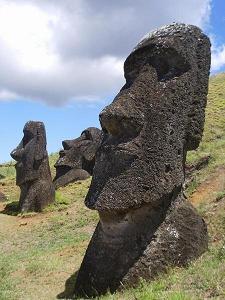
Of course they have bodies! How is this news to anyone? A good part of these statues are well above ground including their bodies, and we've known the sunken ones have bodies below the ground for several decades already.
They've been excavating these statues for quite a while already.
Here, go read the Wikipedia article on Moai, it's way more interesting than this article (which is just a copy of the first few paragraphs of http://www.eisp.org/3879/ with the commentary "wild stuff" added):
I think the fact that they're referred to as Easter Island heads, rather than statues might have had something to do with it :)
More seriously, the iconic pictures of the heads are from Rano Raraku (IIRC), and that is just heads and a bit of neck sticking out of the ground, isn't it?
Well IIRC most moai were placed at the shore or on the cliffs, and the hats were generally rounded. So giant wheel + hill + ocean is definitely going to end with the majority of the hats being lost.
Well, I believe this particular head is the one I've seen most commonly in books[1], and that was quite a long time ago (I wish I could remember if the original Aku-Aku book had pictures.)
Just before people get all excited, to clarify, the great pyramids have 4 sides that are visible and 1 side that faces the ground. Not 5 sides that are visible.
Whenever I see an easter island head, I can't help but draw parallels between our global civilization and theirs.
The eastern islanders consisted of around a dozen tribes, each competing for resources with others. It's thought that all of these statues were put up in a race by chieftains, competing with one another to put up the biggest, most refined and the best statue.
I wouldn't be surprised if they competed in their standards of life too. ("I eat X for breakfast, lunch and dinner!") I certainly wouldn't be surprised by the fact that they might have had political factions, special interests and a life rife with complicated political maneuvering. (it was certainly in the short term interests of statue makers to be against conservation and egg chieftains on)
After all we're the same species and they were just like us.
However what they failed to realize was the inescapable fact that they were living on a small piece of land in the middle of a vast ocean. Their seemingly inexhaustible resources were pitiful by any standards.
As time wore on and their population boomed, a point came when all of these factors came together. Their squandering of resources combined with their unsustainable way of life for a large population faced off with their limited resources, and the result was ugly. Their entire civilization collapsed.
Most of the population was lost to famine. Their civilization descended to cannibalism to survive. This degraded civilization became the perfect breeding ground for disease and even more people died. This cycle went on and on until their entire civilization was wiped out and the entire population nearly eradicated.
I shudder to think what it must have been like to live in this world. It must have been a nightmare.
Today like the eastern islanders with their statues, we keep on building taller and taller structures, better and more lethal weapons, and crazier systems. We compete with one another for status symbols at personal, regional and national levels.
Today we are just as isolated on this tiny blue ball, with a finite amount of resources, a booming population, combined with special interests and huge egos.
Like the eastern islanders we have nowhere to go...
I might be wrong, but I'm sure I read a detailed discussion somewhere about how they analyzed burial pits and found large amounts of cuts as if the flesh had been flayed and so on. Apparently they did detailed DNA analysis and even found human bone fragments in waste pits.
I can't seem to find that discussion online right now. However I did find a rebuttal by Jared Diamond on the same site to this argument;
On a side note I think that it is uncomfortable for us to think about the demise of everything we cherish in this way, and that's why we tend to shy away from discussing this more openly and rigorously.
It's interesting to see how the blog post I cited ended with the same note;
>>>The islanders did inadvertently destroy the environmental underpinnings of their society. They did so, not because they were especially evil or deprived of foresight, but because they were ordinary people, living in a fragile environment, and subject to the usual human problems of clashes between group interests, clashes between individual and group interests, selfishness, and limited ability to predict the future. Does that remind you of any problems that we ourselves face today? That’s why we find Easter’s story so gripping, and why it may offer us lessons. You’ll find good coverage in Bahn’s and Flenley’s new book.<<<
That's the response from Jared Diamond who wrote a book (mentioned in the comments below: "Collapse") with pretty much the same story as yours, of course it will end with a similar conclusion.
Jared Diamond tries to make sense of history in a methodical manner referring to researches done in diverse areas spawning evolutionary biology, archaeology, ecology etc. I would expect any such serious book (though targeted towards readers not steeped in diverse fields which he refers) would appear dry.
Hm. I don't think that's going to be a problem, it might take me a while to read his work, but that's okay. That said, I'm used to such books and a world rife with war, famine, disease and horrible death.
Ok, nice prose of your, but the tiny blue ball thing is bullshit. Any plane on window seat will show you that the Earth is enormous and empty for most it's parts, even in China.
Don't think I advocate more cars and buildings. It's just that the tiny crowded ball argument is wrong, and dangerous, as it can be used to build a nasty antihumanism.
>>>Any plane on window seat will show you that the Earth is enormous and empty for most it's parts, even in China.
Don't think I advocate more cars and buildings. It's just that the tiny crowded ball argument is wrong, and dangerous, as it can be used to build a nasty antihumanism.<<<
I would argue that treating our resources as essentially endless because of the sheer size as compared to the individual fails to take into account that there are now 7 Billion people on this earth. Each and every one of them deserves a better life, they deserve to be able to have a luxurious bath, flush toilets with water, wash hands with water, eat processed foods which take a lot of water to make, wash their cars with water, drink pure water and at the end of the day consume around 315 litres of it. Of course, today not everyone lives like that except for wealthy countries (the statistic is based upon the US) but I think everyone wants a standard of life like that. If somehow, tomorrow 7 billion people started consuming water like that then we would drink up 2 205 000 000 000 litres of fresh water in a day, but the total possible water supply we can access (and this includes the glaciers) is only 3.5 × 10^19 litres...
That's quite an easy way to run out of water.
Now if you do the same with energy, with waste, with consumption and so on what you have is a ticking time bomb waiting to explode. The way we live today just can't last. I think that you can solve this problem using technology, but its roots lie deep in our societies.
What's frightening over here is that there is no way out for us. Unlike our ancestors we simply can't burn and move on. The earth is where we have to make our stand. I really think that it's important for people to start taking the gravity of the situation seriously. We need solutions, and we need them fast. Our time is running out.
I think that there is no greater form of humanism than realizing that all of these people need to be saved from such an horrible end and devoting your entire life to creating a better future.
we would drink up 2 205 000 000 000 litres of fresh water in a day, but the total possible water supply we can access (and this includes the glaciers) is only 3.5 × 10^19 litres...
That's quite an easy way to run out of water.
Water doesn't vanish after it's used. Also, putting your first number in scientific notation helps put this in perspective: 2.2 x 10^12 . Seven orders of magnitude. Close to 15 000 0000 times as much.
That's not to say that work isn't needed to develop cheap recycling appliances, and to build water systems that recycle and reuse waste water rather than dumping it all into the environment, but it's not a very hard problem on the scale of things humanity can accomplish -- it mostly just requires more energy.
Energy will continue to be the limiting factor for a long time, and eventually (after essentially perfect recycling of all material civilization requires) the limit will be waste heat. But as others have mentioned, we have a whole solar system to use as well, and moving the highest heat processes to space would allow us to radiate it away without affecting the earth. Technology which is clearly within our reach would allow the earth to support trillions of humans -- admittedly at a more crowded level than I would prefer. :)
>>> Also, putting your first number in scientific notation helps put this in perspective: 2.2 x 10^12 . Seven orders of magnitude. Close to 15 000 0000 times as much. <<<
Hm, I made a big mistake in that comment. I should have added that we have access to this much, but the real catch is energy and how we are currently limited to tapping into it and the total resource we can access is X.
Thank you so much for pointing this out.
>>> it mostly just requires more energy <<<
Yeah as I argued in another comment, that really is the unmentioned catch over here. I should have elaborated upon that in the parent. Sorry.
Even if most of humanity doesn't reach that level of consumption, we will need to start unlocking some of this resource sooner or later. What really worries me is the amount of energy we need to unlock all of this water locked away in glaciers, ice caps and so on and then actually manage to process and distribute it for final use.
That's a really interesting but hard engineering problem.
>>> Technology which is clearly within our reach would allow the earth to support trillions of humans -- admittedly at a more crowded level than I would prefer. :) <<<
<I>The earth is where we have to make our stand</i>
Why? We have a whole solar system right on on our front porch.
<I>but the total possible water supply we can access (and this includes the glaciers)</I>
Water doesn't just get used once and then disappear forever. Now, one could certainly make an argument against (say) sucking water out of the Oglalla Aquifer faster than it gets replenished, but that's a localized problem. We aren't going to "run out of water". Really.
>>> Why? We have a whole solar system right on on our front porch <<<
This is an honest question, not a rebuttal. How would you get those resources here, or us over there?
>>> Water doesn't just get used once and then disappear forever. Now, one could certainly make an argument against (say) sucking water out of the Oglalla Aquifer faster than it gets replenished, but that's a localized problem. We aren't going to "run out of water". Really. <<<
Well it would have been labored to add that although it would take a large amount of energy to purify water, or perhaps desalinate our oceans, the loop can be closed. The problem really is that it takes resources to keep that loop closed.
I think that all of our issues today boil down to how we convert energy to extract work, if we do manage to make something like fusion work then all of these concerns could be undermined with technology, but how do we get from here to there?
How would you get those resources here, or us over there?
There are a number of high-startup-cost, low-running-cost schemes for putting stuff in LEO, and as someone once said, LEO is halfway to anywhere in the solar system, energy-wise. Some possibilities are laser launching, space elevators, launch loops, and electromagnetic guns.
Some of these have much higher startup costs (to be effective for human launching, a gun would have to be very, very long and possibly cost the most of any of these, but shorter ones could launch material at very high acceleration with much less up-front cost), and some of them have awful failure modes (the space elevator could spread destruction in a narrow path wrapped all the way around the earth if it failed in the wrong way, via separation from the counterweight), but they're feasible.
The cheapest ways of getting to orbit, therefore, approach the cost in electricity of the task, which is less than 10 KwH per kilogram, or about $2USD per kilo. A recent flight from coast to coast cost more than that for me.
I've actually thought about this a bit, and I think that a really interesting design for a launch gun would be to encase the payload in a cover composed of diamagnetic material and then pump liquid nitrogen through channels made inside the material. The material would become perfectly diamagnetic and it will repel all fields, so you can easily levitate it and use it's tendency to go from a stronger to a weaker field to accelerate it.
I don't know for sure, but I think that the main advantage of doing something like this versus just putting a magnet over there, would be the fact that an accelerating magnet in such an assembly would generate huge amounts of back-emf and you would have to a) sink that and b) compensate for that.
However I don't know much about what other people's designs are, but I would like to change that. Do you know any resource where I can learn more from the scratch on how to build something like this?
Also where can I read more in detail about launch loops, laser launching, and space elevators?
Well, you know, I live in Chine since 8 years and, in some ways, there is a profound influence of the "American way of life", mostly through the channel of Holywood movies. The matter could be worse: Chinese have the weight on their side, they can't change so fast as to lose their identity, but still, they have an idea of what should be an happy life that is formatted by these f* movies (really hate then, sorry). For instance, they think everyone should ought to live in an appartement in a tower, own a car, drink canned soda, eat industrial food cooked in microwave, have only one overprotected child, work in suits, go shopping each Saturday, watch baseball on a gigantic TV on Sundays, etc.
They can't believe it when I tell them I am living in a cheap courtyard house, rides a bike to work, never drinks soda, eat home cooked food, never watches TV, know nothing about baseball, climbs mountains on the week-end. In fact, it is the way their parent and grand-parents lives (eg. my neighbors) and the younger generation don't want that, they want the "American way", the supposed "comfort". Maybe a personal taste, but I think Chinese way is better, for me, my family and even for the little big blue ball floating in the universe.
Don't get me wrong: I know US citizen do not live like described, and I tell my friends and colleagues as much as I can. But the problematic part is, again, those f* Hollywood movies that have too much worldwide influence. (I therefore welcome any other influence, Mangas, Bollywood, Hong-Kong kungfu, anything else is better.)
Ok, it may be "trollish" to say that the American way of life is unhealthy and bad for the environment and to express disapproval when this country spread its bad habits around the world. It is true nonetheless.
(Or maybe you think it is OK to eat 1kg of meat/day, own 1 car/person, drive 2h/day, eat burgers and watch TV?)
So facing this issue, two solutions:
1- Human being should be able to consume more, and therefore there need to be less of them.
2- Human being do not need to consume that much to be happy and, therefore, their demographics is not that much of an issue.
"A small amount of resources" does not necessarily have direct correlation with square footage. Even if every part of the earth aside from Europe and NA were empty, there would still be a serious issue with respect to resource consumption.
Population growth has some worrying trends if you start thinking in historical time frames. If we continue to grow as is, until we reach some sort of natural barrier we double the population ever 50-60 years. What will the world look like with 25bn (100yrs) or 100bn (200yrs)? What will it look like @ 1 trillion (say 300- 400 yrs)? Somehwere between 50 & 500 years from now we may know the limit. That's not that long in historical terms and it will probably be a recognizable world. Most of the same countries & cultures will probably still exist. Elvis might still be popular.
If growth does stop what will stop it? Culture (ie middle class western Europe) or something "natural" like famine?
The population growth rate is decreasing (the average number of children per woman is down from 5 in the 1950s to 2.5 today) and in much of the industrialized world, it's already going down.
The population is still increasing, but much of it is no longer due to a high birthrate but due to an increase in lifespan.
> However what they failed to realize was the inescapable fact that they were living on a small piece of land in the middle of a vast ocean.
Their first problem was that they and their palm trees were too big for the island. A big body size means a low population count, and that means that range of random fluctuations overlaps with zero: extinction. This is why island species evolve towards dwarfism: the Flores "hobbits", dwarf elephants, etc. Like many species that are seeded onto an island, they died out before they could evolve to meet the challenges.
The second problem is that humans are not built for a stable, hospitable situation. Our ability to adapt to change atrophies, so that an emergency becomes a catastrophe. (Look up "water empire".) We are built for constant warfare, plagues, droughts, floods, and so forth.
> I shudder to think what it must have been like to live in this world.
About like the sad story of Rhodesia, renamed Zimbabwe and destroyed as an exercise in social justice.
> Like the eastern islanders we have nowhere to go...
If we build big enough, soon enough, we get the inner solar system, whose resources make our current civilization look like a molecule of water in an ocean. Then we can take the gas giants as an afterthought, whose resources make the inner solar system look like a molecule of water in an ocean. Then we get the galaxy.
This blew my mind. I don't know why, I find it incredibly eye-opening that the first thought that one might think of on seeing a head in the dirt (that there's the rest of it underneath) has just simply never occurred to generations of people because we were "told" by someone that they're just heads.
How powerful words can be in casting an illusion, in defeating creativity, and hiding the truth!
Thor Heyerdahl expeditions in mid 50s is what brought Easter Island and its figures to everyone's attention. These were truly captivating adventures, very intriguing and original, and as such they were widely publicized. As a part of the research his team carved, transported and installed a replica figure using only rudimentary tools. And this figure was - wait for it - a head. I would guess that this could've been just the thing that cemented the idea of figures being heads in public's minds, including those of future Easter Island researchers.
A Google Images search for "Easter Island" reveals many heads with above-ground bodies, and a few heads buried up to their noses. That some of the bodies are buried up to the neck should come as no surprise to anyone.
What I wonder is, were these buried statues left like that by the islanders. I mean to get the hat on the statue, the statue has to both be stable and you have to access the head.
So was the easy method of doing this burying the statue? If so how fast did the islanders die off that they couldn't dig out the statues back to their intended state.
What's scary is what these peoples last days must have been like if they abandoned so many of these before completion.
I seriously doubt the easiest way to get the hat on is by digging a massive hole, burying the statue, using the ground around it as a ramp, maneuvering the head into position and then somehow either raising the statue in position or digging out the ground around the hole so that it no longer looks like a hole. I think it's more likely the statues were laid flat, their hats attached and then raised with ropes and blocks of wood and a lot of man power.
Who knows why they were buried, perhaps their religions and customs changed over time and they buried certain heads as a mark of denigration or respect.
My bet would be natural silting and settlement. Easter Island was deforested at some point in its history. New groundwater patterns and a few hundred years could easily sink a few stone statues up to their eyebrows.
Without knowing about the subject, I am curious to know, do you seriously think that [it] "has just simply never occurred to generations of people"...? A lack of physical investigation is not enough to conclude such a thing.
Typically, excavation of ancient peoples' objects has been a very high-priority thing for most people - there's generally a lot of pressure to uncover these artifacts and get a "better understanding" as its usually while in reality being just a big curiosity and a huge source of entertainment.
Just look at the billion dollar business in ancient Egyptian artifacts and momenta, and the attention that new finds in the Nile bring.... and before you say that's not necessarily comparable - look at the at least millions of dollars tourist budget the Easter Island heads have generated each year.
People just LOVE to talk/gossip/guess/BS about past civilizations, and I'd seriously imagine the only reason no one has bothered to dig up a head is simply because no one believed there was anything more to it than a head.
Then there's the fact that we very much call them "heads" - doesn't that speak volumes for the fact that we don't think they have bodies? I also believe there are a number of theories floating around about why the ancients only made heads and not whole bodies (which is absolutely laughable right now).
This is one of the most amazing discoveries I have seen recently. The sheer weight of that stone is absolutely insane. I'm still a little stunned this was just discovered.
I would love to know what the people who made this were thinking. To create a work of art that detailed and massive just to bury 75% of it seems very odd. I'm sure there was a good reason to do it (in their minds at least), I'd love to know what that was.
Just to ameliorate possible confusion, we've known about the bodies since at least the 90's, though possibly earlier. True, that's relatively recent given how old they are, but it's not desirable for readers to come away having concluded that we've just discovered them, like, yesterday.
Thanks for the clarification. Should have guessed that by the clothes in the photos ;). The 90's is still very recent. I'm interested in hearing some of there theories behind why/if they were buried so deeply.
Making stuff and burying it is very common in archeology according to my (limited) knowledge. Chucking stuff as offerings into springs, holes etc as offerings. Burin it with dead people (anyone under that stone is now 2 dimensional).
But I do agree that this seems odd - half burying...
Guess it could be a case of bad foundation, causing it to slowly sink into the ground over many years. Judging the type of ground of the excavation site at the photo, it seems to contain a rather high amount of clay, which is a terrible foundation.
Maybe them just knowing the art is there is good enough. Like painters who paint the back sides of fences[1], or watchmakers who make intricate engravings on the internal parts, because 'God can see it'[2].
I was thinking the same thing. Perhaps originally they weren't buried. Are they designed in such as way as they could have stood upright by themselves?
I would guess that the people doing this work would be able to determine the dirt they were digging into was newer or older than the rock itself.
It's been ages since I read it, but I think that Jared Diamond's book 'Collapse' explains a bit about the island and the statues construction (his main focus is on the self-destructive cycles of behavior of the population however).
Also, I thought this was old news? I'm sure I have seen that photo quite a while ago.
"Though moai are whole-body statues, they are commonly referred to as "Easter Island heads". This is partly because of the disproportionate size of most moai heads and partly because, from the invention of photography until the 1950s, the only moai standing on the island were the statues on the slopes of Rano Raraku, many of which are buried to their shoulders. Some of the "heads" at Rano Raraku have been excavated and their bodies seen, and observed to have markings that had been protected from erosion by their burial."
Read the book "Behold!! The Protong!" and you'll get an even more intriguing explanation. These statues are a WARNING TO THE FUTURE that the great CATACLYSM, which comes in cycles, will HAPPEN AGAIN.
Below the ground-line (which represents the flood survivors emerging from the murk) these statues are holding the "Bi" - an iconic feature representative of the grand CATACLYSM where the balance of water is tipped, and which you can find in almost all ancient artwork, regardless of the culture that creates it - an ocean-covering flood which occurs when the land masses move in reaction to Solar activity.
Easter Island is a WARNING set up by an ancient civilization to protect us from ignorance.
Let us never learn the extent to which SZUKALSKI was RIGHT!
I would have thought quoting SZUKALSKI alone would have set that off, but okay .. not that I'm a huge fan of Zermatism (a subject I would have thought at least a few hackernews visitors might be familiar with) but the ideas of SZUKALSKI are intriguing from the perspective of being able to look outside the box. There is scientific analytical thought, and then there is artistic motive desire, and if you apply both to the same subject you often get surprising results.
In my opinion, the idea of Protong-as-a-warning has quite a bit of validity, if only intelligent minds weren't so easily dissuaded from looking outside their own little boxes now and then ...
If the world was covered with an ocean any time soon (call it the last million years so we can include every human culture) then there would be obvious physical traces, and salt-intolerant species, including plants, would have died.
The oceans move, was his point. I would investigate the science, but the science-fiction of a language called Protong is far more intriguing and worthwhile a pursuit. While I will always respect the mainstream desire to discern the truth, a fiction about Easter Island may be just as valid.
Whenever I see "may" I have to remember that it's essentially meaningless, and your text is equally valid changing it to "may not", as in "a fiction about Easter Island may not be just as valid."
First you say "apply both to the same subject" and now you say that's fiction may be "just as valid."
Szukalski's fiction is 30 volumes of text. You pick out that "the oceans move"? (By which you mean "cover the Earth", not continental drift or tides.) What about that human culture comes from a people on Easter Island, after Noah's flood? How is that fiction at all valid? Races derive from crossbreeding of species, again, after the flood? How is that at all valid?
If it's hard to pick the valid fiction from the invalid, then what's the point? Isn't it like looking up the date by randomly picking a day from this year's calendar?
> Read the FAQ and tell me how a story about art/discovery/paradigm-shifting is OT...
Art, okay. But how is this paradigm shifting?
We already knew they have bodies below surface for at least a couple of decades. And a good deal of the statues are well above ground with their bodies. They're just called "Easter Island Heads" because their heads are often disproportionally large to their bodies. PARADIGM SHIFT!
Though, I do notice that "Easter Island Heads are in fact not merely heads" is not among them. Maybe I should edit that, given the popularity of this story among what are supposed to be a community of knowledgeable and intelligent people :)
Finally, you say it's a story about "discovery". The posted article doesn't really mention anything about a discovery. The original article kind of does: http://www.eisp.org/3879/ Has the same pictures, nearly the same text, maybe it's a bit TL;DR for this crowd given that you even had to summarize your one-sentence post:
> tl;dr hn is not a technews aggregator.
In which case, congratulations to anybody who read this far.
Wow! I just finished reading though the list of common misconceptions. If you were aware of all of those misconceptions am extremely impressed. That list covers an enormous body of knowledge. To be honest I would not have imagined that anyone would know all of those details, congratulations.
So I read the FAQ and guidelines. As far as I can tell the things you mentioned are not specified.
"On-Topic: Anything that good hackers would find interesting. That includes more than hacking and startups. If you had to reduce it to a sentence, the answer might be: anything that gratifies one's intellectual curiosity."
"Off-Topic: Most stories about politics, or crime, or sports, unless they're evidence of some interesting new phenomenon. Videos of pratfalls or disasters, or cute animal pictures. If they'd cover it on TV news, it's probably off-topic."
So did a blog post with 3 pictures and a paragraph of text satisfy your intellectual curiosity? What did you actually learn from this single site? Sure, the pictures are purrdy but it's hardly good content. IMO it matches the off-topic, more than the on-topic. "Moai statues have bodies, more pictures at 11!" An intelligent site aggregator without the bullshit fluff is too much to ask for I guess. I'll be over at lamernews.
That picture was not the least bit awe inspiring to you? That someone along time ago moved huge masses of stone and created something like that?
Its not just me though, apparently a lot of other people liked it too, and it made it to #2 on hn:classic. Why continue this argument? Even in their hayday the big tech aggregators (/. , kuro5hin, etc) had posts that were not OMG, ROFLScale! I wrote a webserver in Clojure+Assembly that runs on my thermostat!
http://www.eisp.org/ has way more information on the topic than the linked blog. I don't think it's off topic, I just think it's a poor article which has no real substance (hence the reddit comparison).
This story is also of interest to the 'classic' HN votes, so it's not like one can argue HN "has changed": http://news.ycombinator.com/classic
Snippet-stuff that makes you rethink something has always been a part of HN. (That said, I prefer it to be a majority of tech stuff myself and usually only submit tech stuff: http://news.ycombinator.com/submitted?id=timf )



They've been excavating these statues for quite a while already.
Here, go read the Wikipedia article on Moai, it's way more interesting than this article (which is just a copy of the first few paragraphs of http://www.eisp.org/3879/ with the commentary "wild stuff" added):
http://en.wikipedia.org/wiki/Moai
Now excuse me while I go submit an article about the Great Pyramids having five sides. Yes mind=blown, I know.