In her defense, she's an insurance lawyer who got onto Trump's good side by bad-mouthing how woke The Smithsonian is. She doesn't exactly have a depth of criminal justice experience to draw from.
The taxing authority (city or county, generally) maintains a list of all the property in tax arrears. Once a year, there is an auction where they go around the room and each bidder can bid a rate for each property; the lowest rate wins a coupon that entitles the bearer to collect the tax plus the rate from the property owner, but requires the bearer to pay the base tax to the taxing authority.
If a few years go by without the property owner retiring the debt, the holder can send a notice with some time requirements and after that, they can sue for the title and then they own the property. Usually the owner pays at the last moment but then they owe attorney's fees.
Adverse possession is completely different and would require living in the tax-delinquent property for several years.
Whole problem is likely the value of the land is less than taxes owed. So any system where county is HAS to get the taxes owed means no one will touch the property.
Thais “whole problem” is precisely what the existing system solves. I bid a future obligation to pay the tax only without the obligation to buy the land. At the end of the year, the county gets the whole tax payment from me.
It’s tempting to talk about “the whole problem” but if you don’t know how the system works it can be hard to see the forest for the trees.
Also I’ve never encountered a situation where the taxes past due exceeded the value of the land. The reason why is that long before this happens, someone already bought the tax debt, waited the statutory period, noticed the delinquent taxpayer, and filed for a quitclaim to transfer the land.
Imagine needing electricity and government contracts so much that you spend $250M to get somebody elected president, and the second thing your guy does in office is cancel all of the projects that could provide you with more electricity.
And then he posts about it literally every day moaning about the lack of power, lack of solar, etc. All the things he bitches and moans about are things he caused by helping elect the orange fella.
The Water Knife is a fun fiction book about exactly this.
The synopsis is that in the near-future water in the west is SCARCE and there are dueling factions (NGOs, state governments, criminals) fighting legally and physically over water, including digging through old libraries and government offices for water right contracts that may be older than the known ones to usurp the standing owner's right.
Usually they have volunteers who do maintenance. At my local tool library the tools are well-used, but there's also like 10 of everything so you have lots of backup options.
most places i’ve borrowed things will seek some basic assurances that i know what i’m doing, first.
for example, when i borrowed a MIG welder, the person at the space asked me to weld some scrap metal in front of them before they let me loose with it.
I would love to see a list of commitments that corporations and foreign bodies have made to investment in the US, and how they've actually played out over time.
They made a similar commitment in 2018 [1] and 2021 [2], but I can't find any info about whether they actually followed through and whether the projected job numbers were accurate.
I'm glad they're doing what it takes to bootstrap the operation. What TSMC does is highly technical and no doubt there will be a ramp up period to build up the labor pool and talent.
Neither TSMC in Arizona or Samsung in Texas were promises made to the Trump admin though. TSMC was announced in May 2020 (tail end of Trump 1) and Samsung was November 2021.
I don't think GP was saying "no one invests in the US," but rather that these particular announcements clearly designed to appease POTUS do not come to fruition.
Yes, because the theater effectively deceives a large portion of the voting public. "Both sides" here are the least important players in the charade. It's everybody they are hosing I care about.
And most who are paying attention are in it for the vibes. They don’t know enough about trade, economics, international relations or policy to really have an opinion independent from “my side good, other side bad”
Not sure - stock market is at all time high, and valuation are above dot com bubble levels. So I think people are actually paying attention and are getting deceived.
Partially true, but the valuation would be much more spread out across the components of S&P500, whereas currently they are extremely concentrated in a handfull of names, and a handfull of others (the ones that CEOs are deceiving the public the most) have sky high valuations without being in any index.
But that's what the voting public wants! They demand to be lied to. The feedback loop is problem announced on Fox news / Truth social -> presidential announcement -> positive coverage on Fox/Truth. It's not like the factory actually has to exist for them to be happy. And if they didn't want to be lied to they wouldn't seek out news sources which lie to them and leave them on in their homes constantly.
> It's not like the factory actually has to exist for them to be happy.
If the factory exists it will be ugly, noisy, shit jobs, exploitative, evil bosses, turning the neighbourhood into a slum, etc. People are happier without it existing.
You say that as if Fox News is the only media org that deceives its viewers. There is a reason that American trust in the media is at an all-time historic low.
Status page says "Incident with Pull Requests". Pull requests status is listed as "Normal". Status text says issue with degraded performance for Webhooks and Issues, does not mention Pull Requests.
As someone who is partially responsible for supporting github at a very large organization, no it isn't. At least not until the incident is at least 30m old if ever.
> hiring managers are satisfied with lowering hiring costs
Since they've added the cost of an AI interviewer, it sounds like their actual satisfaction is derived from not having to properly do a pretty critical part of their job - screening applicants.
So the PO creates a franchise program that they later decide isn't suitable for any sane, good-faith actor, and instead of revising the terms of the franchise program to make it so, they assume that the participants are criminals and prosecute them?
There is a rather famous book written on this subject.
Catch-22.
In order to be given disability you must jump through so many hoops that no one whom is actually sick could complete them. Or how in unemployment you must prove you must spend your time proving you are looking for a job so you cannot spend you time actually looking for a job. My personal fav because its almost universal is sick-day policies that codify 100% abuse of sick days because people are punished for not using them because some people were "abusing" their sick days.
In the case of the book to be discharged from military service they must prove they are insane which no insane person could complete.
Minor correction, but in the book the act of asking to be discharged on account of insanity is taken as proof that one is sane, because no sane person would want to keep flying bombing missions day after day with low odds of survival.
That honestly doesn't make much sense when presented like that. It doesn't seem obvious that every single insane person would pick the insane choice in every scenario. It sounds more like a case of "necessary but not sufficient" in terms of sanity. (I imagine the book probably had plenty more nuance than the oversimplified strawman that I'm criticizing).
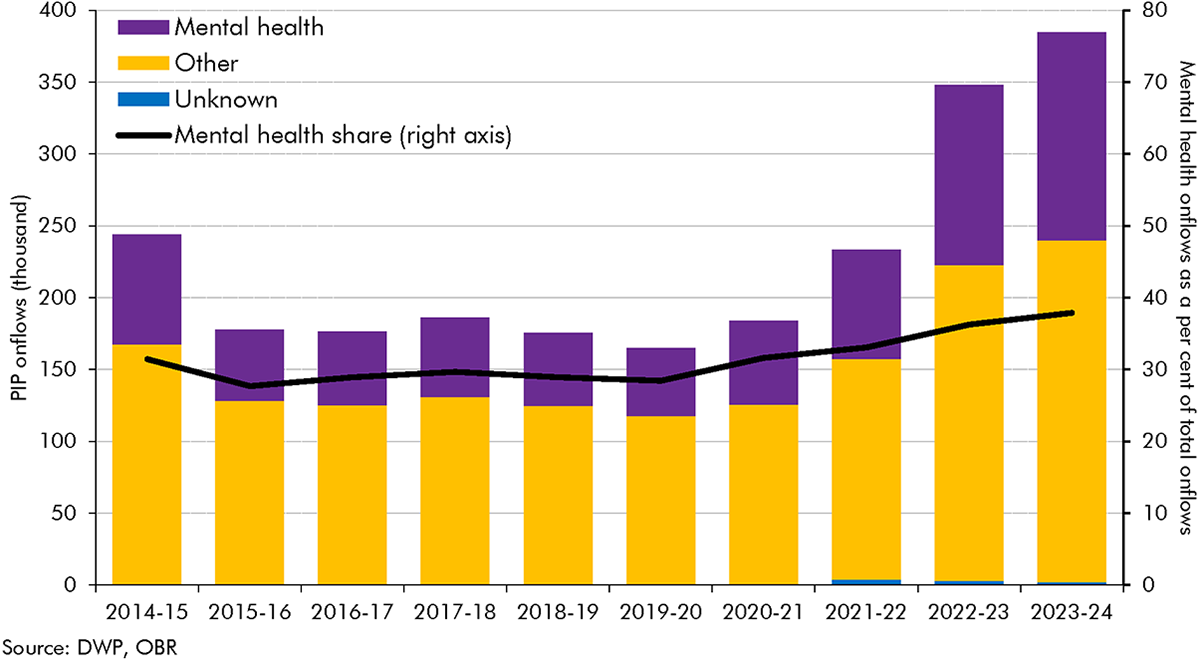
Yeah but in the UK there actually are lots of people claiming benefits that probably shouldn't be. Especially Personal Independent Payments.
It's enough of an issue that even Labour (left wing) is having to deal with it. Though as usual Starmer has chickened out (I think this is like the third thing that was obviously a good move that he's backed down on after dumb backlash).
If you're looking for hard numbers on how many people shouldn't be getting them then you won't find it. Only the government has access to the details of individual claims.
However you can infer a lot from a) the insane rise in claims, especially mental health related:
£400/month help with her bills because she struggles with time management? I'm sympathetic to her problems but that is a shit ton of money!
Even some of the people receiving it agree:
> "I was shocked by the ease with which it was granted. I was expecting to be interviewed, rightly so, but it was awarded without interview and he received backdated pay for the maximum amount."
>
> She was also surprised that her husband got mobility allowance for not having a car, even though she had a car and could drive him around.
(This reminds me of WFA where plenty of people receiving that also thought it was ridiculous.)
> Paul Harris, from Barnard Castle, gets £72.65 a week in PIP payments to help with extra costs associated with his anxiety and depression - such as for specialist therapy apps and counselling.
> Nick Howard, 51, from Cambridge, is neurodivergent and has been claiming Pip for five years.
>
> "Without Pip I would not be able to work as it pays for my transport to and from my workplace.
>
> "I'm currently buying an electric bike on credit, others I have had have been stolen or vandalised," he added.
Great... but I don't think paying PIP for 5 years is a good way to buy someone a bike.
Obviously not all cases are like this, but clearly something has gone wrong. And this isn't a partisan issue. Both parties agree that it has to change. The Tories just ignored the problem and Labour gave up after predictable "N people will die!" press.
And to be clear I'm not anti-poor or anything like that. I also thing WFA is ridiculous and that mostly goes to the rich. Child benefit also goes to lots of people (myself included) who totally don't need it. They all need reform, but look what happens when the government tries...
Right, but they're not, because this isn't what's happening. There's a reason they're paying her. Otherwise you would be getting the money too, but you're not.
The general logic is that money is going to be taken from people no matter what (crime, expensive late interventions, etc.) and that relatively preventative measures are preferable because they cost less while preserving the social contract.
Sorry, but citation needed. Means testing might seem “obvious” from first principles, but from a policy point of view, it makes little to no sense.
The macroeconomic effects of welfare programs create a society that is better for everyone to live in. Reducing the issue to a matter of personal responsibility is a reframing that allows you to completely lose sight of the big picture, and create programs that are destined to fail by not reaching many of the people they need to.
Citation needed for the right to other people's money.
Government running charity interferes with the normal feedback in society. And the need to ask politely, justify one's apparently bad decisions and change failing behavior.
People become "entitled" to regular cash so a lot of the fear that ordinarily motivates the rest of us goes away.
Any system that asks nothing of people is a bad system.
I grew up on welfare. I've also seen how a lot of people on welfare actually live and how they spend their time. They don't spend it cleaning, I can tell you that.
That’s my soapbox — I think that’s the only feasible hope for the future, taking into account increased efficiency, fewer jobs, and higher corporate profits. UBI funded by higher corporate taxes.
I just don’t see any realistic way to make it actually happen.
The ultra wealthy are betting on us lying down and dying in droves while they build techno fascist city states with AI enhanced anti-dissent technology ensuring organised protests are impossible....Its already happening online. Hundreds of thousands of bots appear across platforms sowing doubt about everything until nobody believes anything or anyone strongly enough to get out on the streets and face the army of ai drones.
> Administration of means testing is often more expensive than doing away with the means testing. How about UBI coupled with repealing the minimum wage?
Er... why wouldn't UBI be more expensive?
I'm not even arguing against UBI here, I'm just trying to make sense of your claim, which seems quite dubious.
I would rather we have a system that is too generous and gets taken advantage of than one that is too parsimonious where people die for want of food and shelter that we could provide for them.
We exist in a world where people can be unable to work or even advocate for themselves through no fault of their own. As we raise the bar for how people have to prove that they "need" help, there will be people who die because they don't have the capacity to prove that. In theory we have social workers (as a societal role) but in reality they're underfunded/don't have capacity for the same reasons.
This feels like the same moral argument behind the presumption of innocence in the American legal system: far better to let criminals walk free than to falsely imprison an innocent person. Why do we not apply the same logic to welfare?
I mean, I know why: we're worried the system would get taken advantage of and not serve the people it's "meant" to help.... but then, who does it help? How much effort is it worth making people spend to prove they need help when that effort comes with a blood cost?
I agree with GP that welfare systems make for better societies--see also, public healthcare. I have several friends who are alive because of welfare systems. I grew up with people whose family squandered the welfare they got, but I don't view that as sufficient reason to withhold welfare from anyone else; I just accept that's the cost of a system that helps people.
I'd also rather people get "free" benefits and perhaps spend some of their time doing something creative or otherwise useful to society but which doesn't pay than force everyone to take a job no matter how useless or even destructive it is.
Citation needed that your neoliberal views are anything other than bad faith voodoo economics. We have decades' worth of proof that it's toxic for society, both politically and economically. Your whole talking point is an excuse for the ultra rich to get even richer through mass exploitation, which ironically is the embodiment of entitlement that you're so opposed to.
I think this is the parent’s point: this is the POV of the rich and powerful who lead the organization. They can’t imagine someone in a different position seeing these franchises as a way to secure good (or at least decent), long-term, stable employment.